
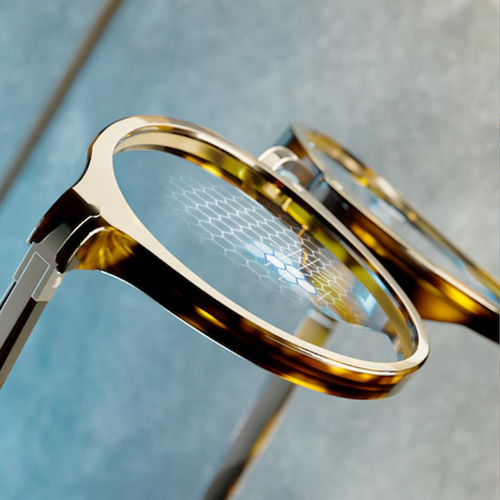
How Progressive Lenses Work: 4 Design Tiers Explained
Progressive lenses correct distance, intermediate and near vision in a single lens, with no visible dividing line and no jump between zones. They are the modern answer to presbyopia, the gradual loss of near focus that begins for most people in their mid-forties. Our certified optometrists at the Lawrence and Mayo Boutique fit these lenses daily, so this guide explains how they work, what adaptation involves and how to choose the right design.
What You Will Learn
- How the three vision zones are arranged
- Progressive against bifocal and occupational lenses
- What adaptation actually feels like
- The four design tiers and what you gain from each
- Why fitting matters more than with any other lens
How Progressive Lenses Work
Progressive lenses are a single piece of material with a gradually changing curvature from top to bottom. That gradual change is what creates three usable zones without any visible line.
The upper portion carries your distance correction, which is what you look through when walking, driving or watching something across a room.
The middle band, known as the corridor, carries the intermediate correction. This is the zone you use for a computer screen, a car dashboard or anything at roughly arm’s length.
The lower portion carries the reading correction, used for a book, a phone or a menu.
Because the power changes continuously rather than in steps, your eyes move smoothly between distances rather than jumping. That seamlessness is the entire advantage over the alternatives.
The Trade-Off Nobody Explains
There is one honest limitation of progressive lenses worth understanding before you buy.
Creating a smooth power change across a curved surface produces a small amount of distortion at the lower outer corners of the lens. This is a consequence of the optics, not a manufacturing fault, and every progressive lens ever made has it.
In practice most wearers stop noticing it within a fortnight, because the eye learns to look through the corridor rather than around it. Better lens designs reduce the distorted area considerably, which is precisely what you pay for when you move up the tiers.
Progressive, Bifocal or Occupational
| Lens Type | Zones | Visible Line | Best For |
|---|---|---|---|
| Progressive | Distance, intermediate, near | No | Everyday all-round use |
| Bifocal | Distance and near | Yes | Simplicity, no intermediate need |
| Occupational | Intermediate and near | No | Desk and screen work |
| Single vision reading | Near only | No | Reading in a fixed position |
Bifocals are simpler and cheaper, but they skip the intermediate zone entirely, which matters more now than it did a generation ago because so much of daily life sits at screen distance.
Occupational lenses are the option most people have never heard of. They sacrifice the distance zone in exchange for a much wider intermediate and near area, which makes them excellent as a second pair for anyone working long hours at a desk.
The 4 Progressive Lens Design Tiers
Not all progressive lenses are equal, and the difference is genuinely noticeable.
| Tier | Corridor Width | Adaptation | Best For |
|---|---|---|---|
| Standard | Narrow | Longest | Occasional wear, tight budgets |
| Enhanced | Moderate | Moderate | General daily wear |
| Premium | Wide | Short | Full-time wearers |
| Personalised | Widest | Shortest | Demanding prescriptions and screen work |
Higher tiers use more sophisticated surfacing to widen the usable corridor and push the peripheral distortion further out towards the lens edge. Personalised designs go further by accounting for your individual frame fit, how you hold your head and your reading distance.
If you wear glasses all day, the upgrade from standard to premium is the single most noticeable improvement available. If you wear them occasionally, a standard design is perfectly adequate.
What Adaptation Feels Like
Most people adapt to progressive lenses within one to two weeks. A few adapt within days, and a small number take a month.
In the first few days you may notice slight swimming at the edges of your vision when you turn your head quickly, and you will need to learn to lower your eyes rather than your chin to read.
Three habits speed it up considerably. Wear them full time rather than switching back to your old glasses, point your nose at what you want to see, and take stairs slowly for the first week, since the reading zone sits where you would normally look down at your feet.
If discomfort persists beyond two or three weeks, return to your optometrist. It usually indicates a fitting adjustment rather than a wrong prescription, and our eye testing and fitting services can correct it in minutes.
Choosing a Frame for Progressive Lenses
Frame choice matters more with progressive lenses than with any other lens type, because the three zones need vertical space to sit in.
A lens depth of at least 28 to 30 millimetres is the usual minimum. Very shallow rectangular frames compress the corridor, which shortens each zone and makes adaptation harder.
Adjustable nose pads are a genuine advantage, because they let an optometrist set the exact height at which the corridor sits in front of your pupils. Frames that slide down the nose move the reading zone with them, which undoes the fitting entirely.
Why Fitting Decides Everything
With single vision lenses a small fitting error causes minor strain. With progressive lenses it can make them unusable.
Four measurements matter: pupillary distance, fitting height, pantoscopic tilt and vertex distance. Together they position the corridor so that your eyes fall naturally into each zone as you change focus.
This is why they should never be bought without an in-person fitting. Every number can be correct on the order form and the finished pair still fail, because the frame has to be adjusted on your face. Our boutique services team takes all four measurements as standard.
Progressive Sunglasses
Progressive lenses work in sunglass frames too, with solid, gradient or polarised tints.
One point worth raising with your optometrist: head position outdoors differs from head position while reading indoors, so the corridor placement is often set slightly differently in a sunglass pair. Mention how you intend to use them.
The Verdict
Progressive lenses are the most comfortable solution to presbyopia available, provided you choose a design tier that matches how much you wear them, pick a frame with enough lens depth, and have the fitting done properly. Give them a fortnight and most people never think about the zones again. To find your pair, book through our home eye test and boutique services or visit the Lawrence and Mayo Boutique →.
Frequently Asked Questions
How do progressive lenses work?
A single lens with gradually changing curvature creates three zones: distance at the top, intermediate in the middle and reading at the bottom, with no visible line.
What is the difference between progressive and varifocal lenses?
None. They are two names for the same lens. Varifocal is the more common term in Britain and India, progressive in America.
How long does adaptation take?
Usually one to two weeks. A few people adapt within days, and a small number take up to a month.
Why do the edges look blurred?
A small amount of distortion at the lower outer corners is a consequence of the optics. Higher lens tiers reduce the affected area considerably.
Are progressive lenses better than bifocals?
For most people, yes. Bifocals have no intermediate zone, which matters when so much of daily life sits at screen distance.
Which design tier should I choose?
Premium or personalised if you wear glasses all day. Standard is perfectly adequate for occasional wear.
Do they work in any frame?
The frame needs a lens depth of at least 28 to 30 millimetres. Very shallow frames compress the corridor and make adaptation harder.
Can I get progressive sunglasses?
Yes, in solid, gradient or polarised tints. Tell your optometrist how you plan to use them, since corridor placement differs outdoors.
What if I cannot adapt to them?
Return to your optometrist. Persistent discomfort after two or three weeks usually indicates a fitting adjustment rather than a wrong prescription.
Where can I get progressive lenses fitted in India?
At the Lawrence and Mayo Boutique, where certified optometrists take all four fitting measurements and adjust the frame in person.
Leave a Reply